
Migration overview
Key Results
- Monthly traffic and growing
- ~Approximately 100,000
- Melbourne news sites merged
- 5 → 1Five into one
- Local areas tracked in Looker Studio
- 11
- Article and archive URLs mapped
- Thousands
- More appearances in Google News and Discover
- Higher visibility
- The Melburnian appears more often in AI answers
- More AI mentions
Hyperlocal News brought five established Melbourne news websites together in a single launch. The move involved thousands of article and archive URLs, a new site covering 11 areas, and a new way to measure how readers found and engaged with local news.
Plumtree SEO planned the migration, worked with the development team on the URL mapping and launch, and built a custom Looker Studio dashboard for the publisher. The Melburnian now records around 100,000 in monthly traffic, with traffic trending upwards and articles gaining more visibility in Google News and Discover.
The Challenge
Hyperlocal News had spent more than two decades building an audience for local journalism. Its five publications were CBD News, Docklands News, Southbank News, Inner City News and North West City News. In 2026, the publisher brought those mastheads together as The Melburnian.
Each website had years of stories and archives. Readers could find an article through Google, follow a link from another website or open a story someone had shared. Every one of those routes depended on an old URL taking the reader somewhere relevant after launch.
The new site also covered 11 areas, so reporting had to change. The publisher needed a single view of how The Melburnian was performing, with enough detail to see which locations were attracting readers, which stories they were sharing and whether they were clicking advertiser links.
The Solution
We benchmarked all five sites before launch
We audited each legacy site separately. We looked at what ranked in search, which pages attracted traffic, which URLs had earned backlinks and where the publications appeared in AI-generated answers.
That gave us two things to work with. The combined analytics baseline gave us a way to measure the new site after launch. The page-level findings helped us prioritise URLs where a missed redirect could cost the publisher an established route to its content. An older article could still matter if people were finding it in Google or another site was sending readers to it.
We mapped thousands of article and archive URLs
The URL map connected old pages to their destinations on The Melburnian. It covered individual stories and archive pages across all five domains. The aim was to send someone opening an old article link directly to the story on the new site whenever it had a corresponding page.
That mapping also gave the developers a shared reference for implementing and checking redirects. With all five domains moving at once, the team needed to agree on where old URLs should lead before the launch. We used a shared project plan to coordinate the work, from pre-launch benchmarking and URL mapping through to launch checks and post-launch monitoring.
We also used Google Search Console’s Change of Address tool to notify Google of the domain moves after redirects were in place. The redirects handled visits to individual URLs, while Change of Address told Google about the move at domain level. Search Console Help
The development team deserves real credit. They built a site that looks fantastic and turned a detailed migration plan into a single coordinated launch. Plumtree SEO led the SEO planning and measurement, and the developers made that work on the new platform.
We built a custom Looker Studio dashboard for an 11-area newsroom
We built the dashboard in Data Studio, formerly Google Looker Studio, around how Hyperlocal News would use it after launch. The publisher could open it for a snapshot of the whole site, look at any of the 11 coverage areas, or drill down to see how individual articles performed.
Dashboard view |
What it helped the publisher see |
|---|---|
Site-wide performance |
How traffic to The Melburnian was trending against the combined pre-launch benchmark |
Location snapshots |
How each of the 11 coverage areas was performing within the wider publication |
Article performance |
Which individual stories attracted readers |
Story shares |
Which articles readers shared through tracked sharing actions |
Advertiser link clicks |
How often readers clicked tracked links to advertisers |
During the migration, the dashboard helped Hyperlocal News follow traffic against its baseline. Once the site was live, it became a tool for day-to-day publishing and advertiser reporting. The team could see where readership was growing, which stories people were sharing and how often readers acted on an advertiser link.
The Results
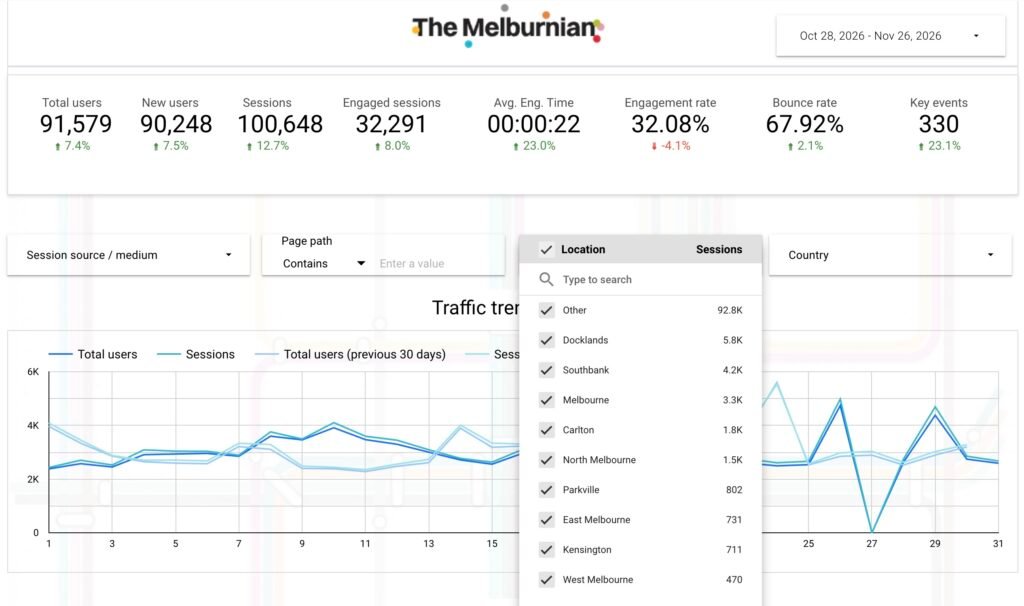
Five Melbourne news websites moved onto one platform in a single launch. The Melburnian now records around 100,000 in monthly traffic, and post-launch reporting shows that traffic is continuing to grow.
The publisher is also seeing more visibility for its stories in Google News and Google Discover, alongside an increase in mentions in AI-generated answers. With the new reporting in place, Hyperlocal News can follow how readers discover The Melburnian and see what they do once they arrive, down to individual stories and coverage areas.
Frequently Asked Questions
Why did Hyperlocal News merge five websites into The Melburnian?
Hyperlocal News wanted to bring its five local mastheads together under one publication. The Melburnian gives readers a single place to find local news across 11 Melbourne areas while retaining access to stories from the original publications.
How did you handle thousands of old article and archive URLs?
We mapped old URLs to relevant destinations on The Melburnian and used traffic, rankings and backlinks to identify which pages needed particular attention. The development team used that map to implement redirects. Once the redirects were in place, we used Google Search Console’s Change of Address tool to notify Google of the domain moves.
What did the custom data Studio dashboard track?
The dashboard gave Hyperlocal News a site-wide snapshot and a breakdown of performance across all 11 coverage areas. It also showed how individual articles performed, which stories readers shared through tracked actions, and how often they clicked advertiser links. That made it useful for both editorial and advertiser reporting after launch.
How did you measure the success of the SEO migration?
Before launch, we benchmarked performance across the five legacy websites. After launch, we used that baseline to track how traffic to The Melburnian developed. The site now records around 100,000 in monthly traffic and is trending upwards. Its stories are also appearing more often in Google News and Discover, and mentions in AI-generated answers have grown.
Can you work with our existing web development team on a site migration?
Yes. On this project, Plumtree SEO led the SEO audit, benchmarking, URL mapping and reporting. The development team built the new site and implemented the migration. We worked together on the launch plan so the developers had clear requirements and the publisher could track performance once the site went live.
Planning a website migration?
If you’re changing domains, rebuilding your website or bringing several sites together, we can help you identify the pages that drive traffic, give your development team a clear migration plan and build reporting around the results you need to measure.
Client Feedback