

Campaign overview
Key Results
- Reduction in cost per lead
- 77%
- Increase in leads
- 436%
- Increase in conversion rate
- 312%
- States targeted
- 14
- Demand Gen impressions
- 62,000
- Campaign period
- to
Following its acquisition by Hurst Lending, Ribbon Home needed more than a new website and updated positioning. It needed a reliable way to reach homeowners actively looking for an alternative way to buy their next property before selling their current one.
Plumtree SEO created a Google Ads strategy built around two distinct audiences. Search campaigns captured existing borrower demand, while a visual Demand Gen campaign helped Ribbon reconnect with real estate professionals who could introduce the programme to suitable clients.
The result was a 77% reduction in cost per lead and a 436% increase in leads between the initial and latest reporting periods.
The Background
In 2025, Hurst Lending acquired key Ribbon assets and relaunched Ribbon Home as an alternative home finance lender.
The relaunched business is different from the previous Ribbon model. Its focus is now on lending products that help people overcome real-world property and financing challenges. Its flagship Buy Before You Sell programme enables eligible borrowers to purchase their next home before their existing property has sold.
Plumtree SEO had already supported the acquisition by rebuilding RibbonHome.com, integrating its lead-generation systems and creating a scalable SEO foundation.
Read how we rebuilt Ribbon Home’s website, CRM and SEO foundation following the acquisition.
With that platform in place, the next priority was targeted acquisition.
Ribbon needed to reach prospective borrowers in the states where its loans were available. It also wanted to reintroduce the brand to real estate professionals who regularly work with clients caught between buying and selling.
The Challenge
This was not a routine mortgage PPC campaign.
Ribbon had changed ownership, positioning and product focus. Some people still associated the brand with its previous model, so the advertising needed to communicate the new offer clearly and quickly.
There were several practical challenges:
Buy Before You Sell financing is unfamiliar to many borrowers.
Mortgage-related search terms can be competitive and expensive.
Ribbon could only lend in selected U.S. states, making accurate geographical targeting essential.
Homeowners and real estate professionals had different needs and required different messages.
Lead quality mattered more than a large volume of low-intent form submissions.
Financial advertising required careful handling of claims, disclosures and targeting. Google’s financial products and services policy also requires advertisers to follow the relevant rules for every location they target.
The existing account also had a more fundamental problem. The conversion data feeding Google’s bidding system did not provide a clear enough picture of which enquiries were genuinely valuable.
“When we took over the account, the two biggest issues were the quality of the data feeding the campaigns and weak relevance between searches, ads and landing pages. Improving those signals gave Google a much clearer picture of the right customer. That helped us reduce cost per lead quickly while improving conversion performance.”
Ged Prantkelenas, Google Ads Specialist at Plumtree SEO
Campaign Objectives
We agreed four main objectives:
Generate relevant borrower enquiries for Ribbon’s Buy Before You Sell programme.
Focus the advertising budget on states where Ribbon could provide loans.
Reach real estate professionals who could refer suitable clients.
Build more reliable conversion data for future optimisation and budget decisions.
This kept the campaign focused on commercial outcomes rather than clicks and impressions alone.
The Google Ads Strategy
We combined high-intent Search campaigns with a separate Demand Gen campaign. Each had a different role within the customer journey.
Search allowed us to reach homeowners already looking for a solution. Demand Gen used visual creative and audience signals to build familiarity with real estate professionals who may not have been searching for Ribbon at that moment.
1. Capturing Active Borrower Demand With Search Ads
The Search campaigns targeted people researching how to buy another home before selling their current property.
Rather than relying only on industry terms, the ads focused on the problem the borrower was trying to solve. Search themes included bridge loans, Buy Before You Sell programmes and finance for purchasing a new home before an existing one had sold.
We used a combination of phrase and exact match keywords. This gave us enough control to prioritise strong intent while continuing to discover useful variations in the language borrowers used.
Regular search-term reviews helped us identify irrelevant queries. Negative keywords were then used to exclude people looking for information or services Ribbon did not provide.
We did not divide the account into dozens of small campaigns. Over-segmentation can leave each campaign with too little conversion data to support reliable optimisation.
Instead, we created a more consolidated structure around intent, location and the available budget.
“We deliberately avoided spreading the budget across too many campaigns. Consolidating the structure gave the bidding system enough data to learn, made wasted spend easier to identify and helped us direct the budget towards campaigns producing stronger results.”
Ged Prantkelenas, Google Ads Specialist at Plumtree SEO
2. Controlling Spend Across 14 States
Ribbon’s loans were available in selected markets, so location targeting could not be treated as a basic account setting.
The campaign covered:
Alabama
Colorado
Florida
Georgia
Idaho
Iowa
Louisiana
Oklahoma
Oregon
Pennsylvania
Tennessee
Texas
Virginia
Washington
This structure stopped budget being spent in markets Ribbon could not serve.
It also gave us greater control over how the budget was distributed. Allocation could be adjusted using campaign efficiency, seasonal demand and Ribbon’s commercial priorities rather than applying the same approach to every state.
3. Aligning Ads With the Landing-Page Experience
A strong keyword or advert cannot compensate for a weak landing page.
People searching for Buy Before You Sell finance need to understand what the product does, who it may suit and what happens next. The landing-page messaging therefore reflected the intent behind the ads and focused on practical outcomes rather than unexplained lending terminology.
Clear calls to action encouraged users to enquire or begin the approval process. Behaviour data also helped us identify where visitors lost interest, which sections held their attention and where the journey could be improved.
This work drew on Plumtree SEO’s wider Google Ads management, conversion optimisation and Google Analytics consulting capabilities. It meant the campaign, website and measurement setup worked as one system.
4. Reaching Real Estate Professionals With Demand Gen
Search advertising captured people already looking for a financing solution. Ribbon also needed to remain visible to real estate professionals who encounter the same problem from the other side of a transaction.
A separate Demand Gen campaign used visual creative with keyword-based signals and an eligible custom audience built from nearly 10,000 contacts. This helped Ribbon reach relevant real estate professionals with messaging tailored to their priorities.
The creative focused on how Ribbon could help agents keep transactions moving, support clients who needed to buy before selling and reduce the pressure created by a home-sale contingency.
The best-performing static advert used the headline:
Bought first. Sold later without pressure.
The campaign generated 62,000 impressions and an 8.86% click-through rate during the reporting period.
Google describes Demand Gen as an audience-led campaign type designed to generate interest and action through visual placements across its network. It complemented Search by allowing Ribbon to communicate the offer before someone made a direct product search.
Improving Conversion Tracking and Lead Quality

Conversion tracking
From Ad Click to Funded Loan
Tracking the complete customer journey helps us optimise campaigns for meaningful business outcomes, not just clicks.
Ad Click
Someone engages with a Search or Demand Gen advert.
Website Lead
Enquiry form, phone call, consultation or partner enquiry.
Qualified Opportunity
The CRM identifies whether the lead is relevant and eligible.
Loan Application
The prospective borrower starts or completes an application.
Funded Loan
The completed outcome is connected back to the campaign.
CRM and offline conversion data can be fed back into Google Ads, helping Smart Bidding focus on higher-quality opportunities.
An enquiry is useful to a lender only if it comes from someone who may be eligible and has genuine intent.
We reviewed the conversion setup so the campaigns were not optimising towards low-value actions. Tracking covered website enquiries and phone calls, with CRM and offline conversion data used to give the account better information about what happened after the initial contact.
Across the wider campaign period, the account recorded:
Campaign Tracking Results
Metric |
Result |
|---|---|
Website enquiries |
63 |
Phone leads |
118 |
Overall website conversion rate |
3.04% |
These are tracked conversion actions. We have not labelled every action as a qualified lead or completed loan because those outcomes require further sales and underwriting data.
That distinction matters. Optimising towards every form submission can encourage an advertising platform to find more people likely to complete a form, but not necessarily more people likely to become customers.
Feeding CRM outcomes back into Google Ads helped the campaigns learn from stronger signals. Google’s guidance on offline conversion imports explains how advertisers can connect an ad click or call with later outcomes that happen away from the website.
Ongoing Campaign Optimisation
The initial launch created a starting point. The performance gains came from what happened next.
Our ongoing work included:
Reviewing search terms and expanding negative keyword lists.
Testing benefit-led and product-led ad messaging.
Monitoring performance by state and search theme.
Moving budget towards more efficient campaigns.
Improving the connection between ads and landing pages.
Reviewing visitor behaviour to find conversion barriers.
Refining conversion actions and offline data.
Using conversion-based Smart Bidding once the account had better data to learn from.
The most important changes were the introduction of better audience information and offline conversion tracking. These gave Google clearer feedback and reduced its reliance on surface-level website actions.
The Results
The account became more efficient as the campaign developed.
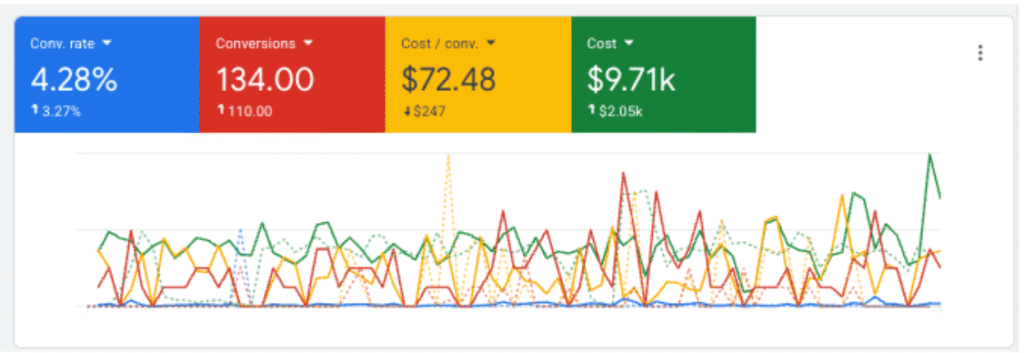
Lead volume increased from 25 in the initial reporting period to 134 in the latest period. At the same time, cost per lead fell from $311 to $72.48.
Campaign Performance
| Performance measure | Initial period | Latest period | Change |
|---|---|---|---|
| Ad spend | $7,780 | $9,710 | +25% |
| Impressions | 22,400 | 40,000 | +79% |
| Click-through rate | 10.71% | 7.83% | -27% |
| Average cost per click | $3.25 | $3.10 | -5% |
| Leads | 25 | 134 | +436% |
| Conversion rate | 1.04% | 4.28% | +312% |
| Cost per lead | $311 | $72.48 | -77% |
The click-through rate fell as reach expanded, but that did not make the campaign less effective. The conversion rate rose sharply, lead volume increased and the average cost per click declined.
That is an important distinction. A higher click-through rate can look impressive in isolation, but the more valuable question is whether the campaign is generating useful enquiries at a commercially sensible cost.
Business Impact
Ribbon now has a more repeatable paid acquisition channel for its Buy Before You Sell programme.
The state-specific setup gives the lender greater control over where its advertising budget is spent. Search captures homeowners while they are actively exploring their options, while Demand Gen keeps the brand visible to real estate professionals who can influence future referrals.
The campaign also connects with the website, analytics and CRM infrastructure created during the wider Ribbon relaunch. This gives the team better information about which locations, searches and messages are producing the strongest opportunities.
Most importantly, the account is now structured to learn from better data. That creates a stronger foundation for expanding into additional states, testing new products and increasing spend without losing sight of lead quality.
You can also read how our wider financial services SEO strategy helped Hurst Lending grow its organic visibility.
Frequently Asked Questions
Can Google Ads work for mortgage lenders?
Yes. Google Ads can place a lender in front of people actively searching for a mortgage or specialist finance solution. However, performance depends on precise targeting, compliant messaging, relevant landing pages and accurate conversion tracking. High search volume alone does not guarantee qualified enquiries.
How did Plumtree SEO reduce Ribbon’s cost per lead?
There was no single quick fix. We improved the campaign structure, removed irrelevant searches, aligned adverts with landing pages and fed better conversion data back into Google Ads. Together, these changes reduced cost per lead from $311 to $72.48 between the initial and latest reporting periods.
Why were the campaigns divided by state?
Mortgage availability and licensing vary by location. State-level control helped prevent spend outside Ribbon’s eligible markets and allowed budgets to reflect demand, efficiency and commercial priorities in each area.
What was the role of Demand Gen?
Demand Gen supported the high-intent Search campaigns by using visual advertising to reach relevant real estate professionals. It helped Ribbon explain the practical value of Buy Before You Sell before those users necessarily searched for the product directly.
Does Plumtree SEO manage Google Ads for finance companies?
Yes. Plumtree SEO provides Google Ads management services for lenders, financial-services companies and businesses in other competitive sectors. Our work covers campaign strategy, keyword targeting, advert creation, landing-page recommendations, conversion tracking and ongoing optimisation.
Need Better Leads From Google Ads?
Generating clicks is easy. Building a paid search campaign that reaches the right customers, measures genuine enquiries and supports your sales process takes a more considered approach.
Plumtree SEO creates and manages conversion-focused Google Ads campaigns for mortgage lenders, finance companies and businesses in competitive markets.
Client Feedback