SEO used to be simple.
You chose a keyword, created a page, built some links, and tried to rank on Google.
That model still exists. But it’s no longer the full picture.
Today, people don’t just search. They ask.
They ask ChatGPT. They ask Google. They ask tools like Perplexity and Gemini.
And instead of showing a list of websites, these platforms give a direct answer.
That changes everything.
Because now, it’s not just about ranking.
It’s about being included.
If your business isn’t part of that answer, you’re invisible.
In this guide, we’ll break down what’s changed, what AIO and GEO actually mean, and how you can start showing up in AI-driven search.
If you’re new to SEO, it’s worth first understanding the basics in our guide to what SEO is, as this builds on those fundamentals.
Key Takeaways
- SEO is no longer just about rankings. It’s about being included in AI-generated answers.
- AI tools like ChatGPT, Google AI Overviews, Perplexity, Claude, and Gemini are changing how people search.
- AIO (AI Optimisation) helps AI understand your business and content.
- GEO (Generative Engine Optimisation) helps your business get mentioned and recommended in AI responses.
- Visibility now comes from more than your website. Brand mentions, LinkedIn activity, and industry presence all matter.
- Keyword research has shifted from exact terms to questions and intent.
- Backlinks still matter, but brand mentions and consistent presence are becoming just as important.
- To show up in AI search, you need clear content, consistent messaging, and visibility across multiple platforms.
What Is AI Search?
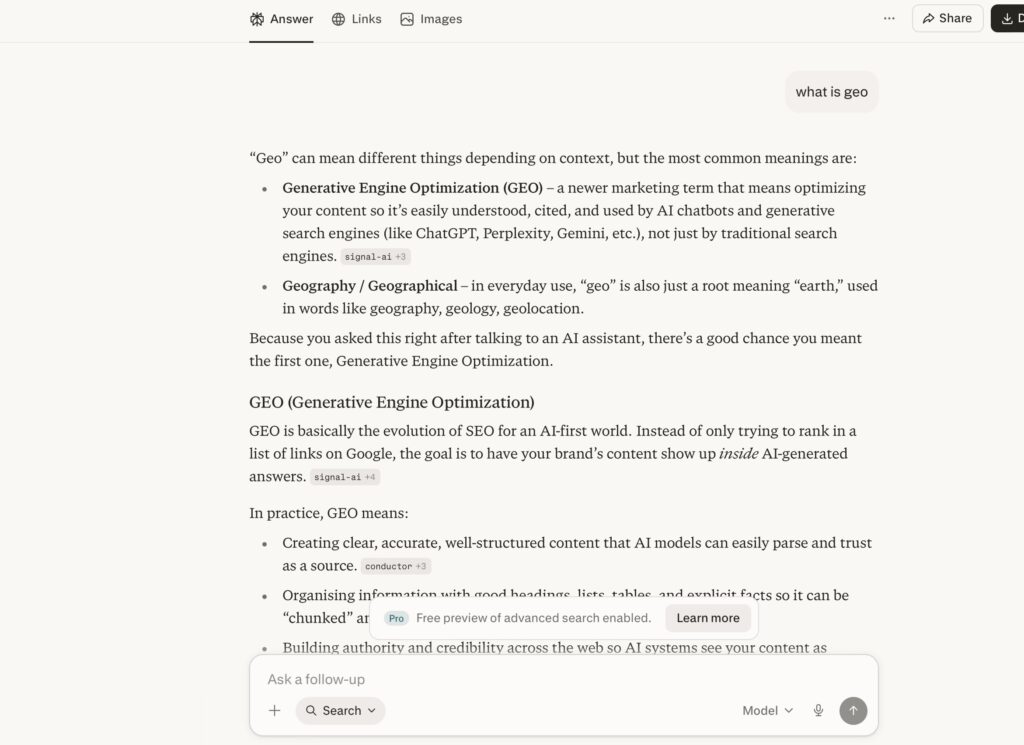
Before we get into AIO and GEO, it’s worth understanding what we mean by AI search.
It’s easy to think of it as just another version of Google. It’s not.
Traditional search shows you options.
You type a query, and Google gives you a list of pages. You choose what to click.
AI search works differently.
It reads, summarises, and decides what matters. Then it gives you a single answer, often pulled from multiple sources.
You’ll see this in:
- Google AI Overviews
- ChatGPT
- Claude
- Perplexity
- Gemini
Instead of ten blue links, you get a response.
Sometimes with sources. Sometimes without.
The key difference is this:
Search engines rank pages.
AI tools select answers.
And that means your goal is no longer just to rank.
It’s to be included in what the AI chooses to show.
The New SEO Landscape (SEO vs AIO vs GEO vs AEO)
Before you can improve your visibility, you need to understand how the landscape has changed.
There are a lot of new terms being thrown around. Most of them describe the same shift from different angles.
Let’s keep it simple.
Traditional SEO is still about ranking.
You target keywords, optimise your pages, and aim to appear in search results.
That hasn’t gone away. But it’s no longer enough on its own.
Now you also have:
AEO (Answer Engine Optimisation)
This focuses on answering specific questions clearly.
Think featured snippets, FAQs, and direct answers.
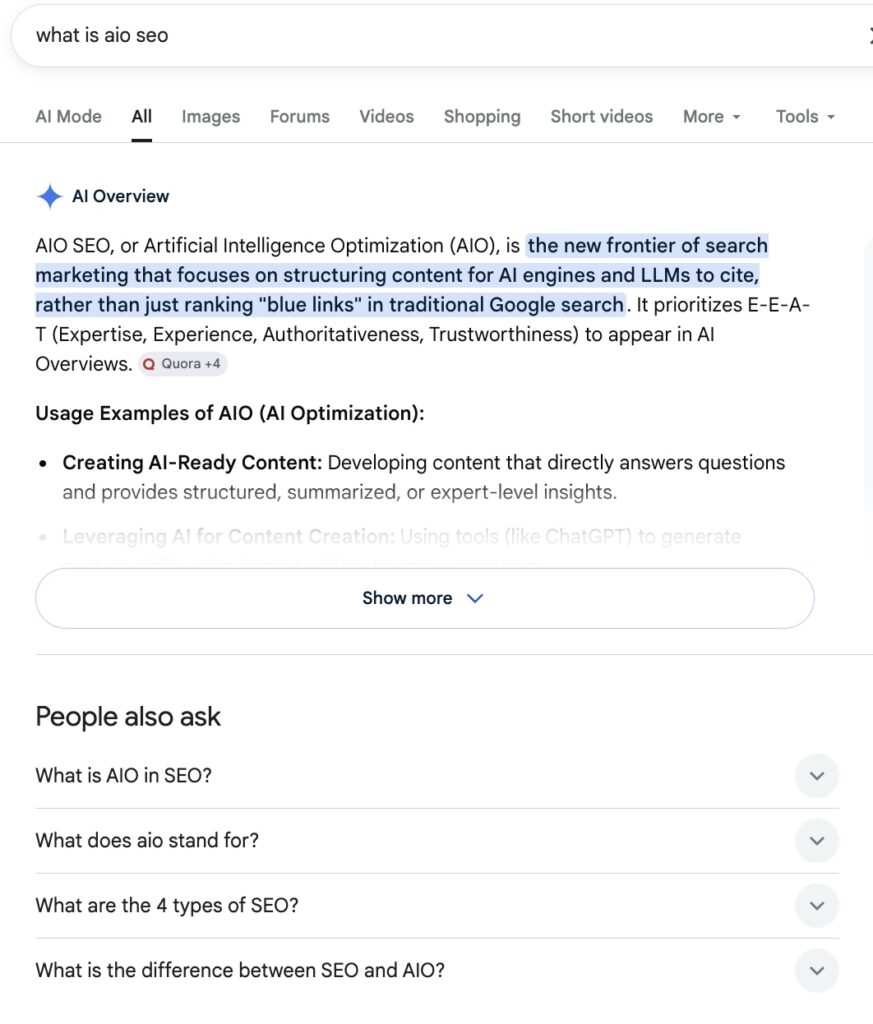
AIO (AI Optimisation)
This is about helping AI understand your content and your business.
If AI can’t clearly interpret what you do, you won’t be included.
GEO (Generative Engine Optimisation)
This goes a step further.
It’s about being recommended, mentioned, or cited when AI tools generate responses.
That’s the real shift.
You’re no longer just competing for rankings.
You’re competing to be selected.
And selection works differently.
Search engines look at pages.
AI looks at patterns.
It looks for:
- consistency
- clarity
- authority
- repeated mentions
That’s why some businesses appear in AI answers… and others don’t, even if they rank well.
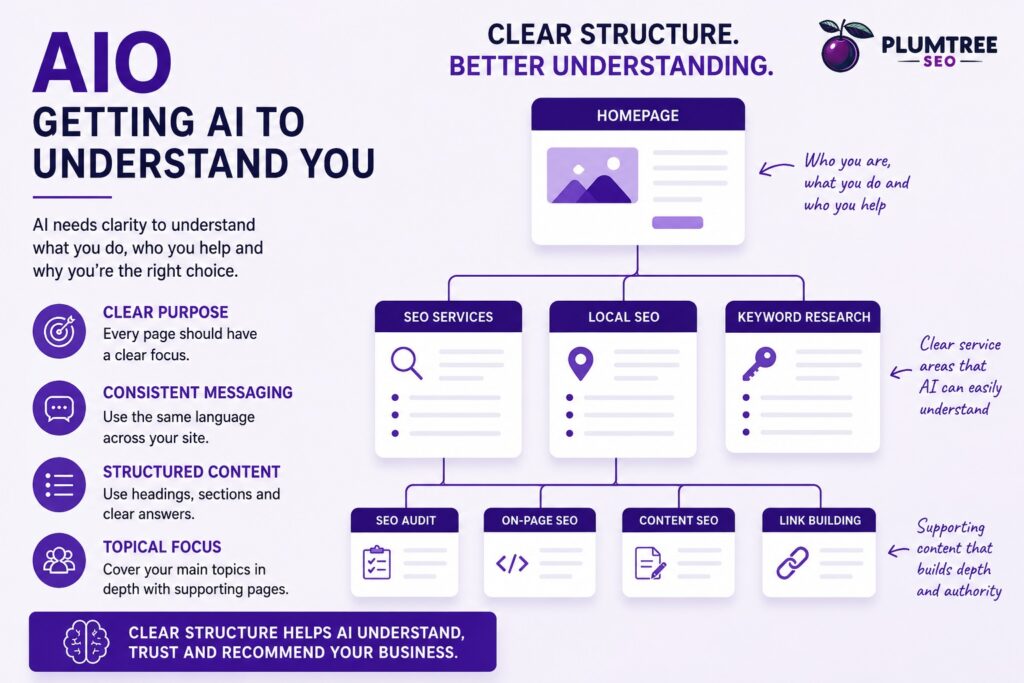
AIO – Getting AI to Understand You
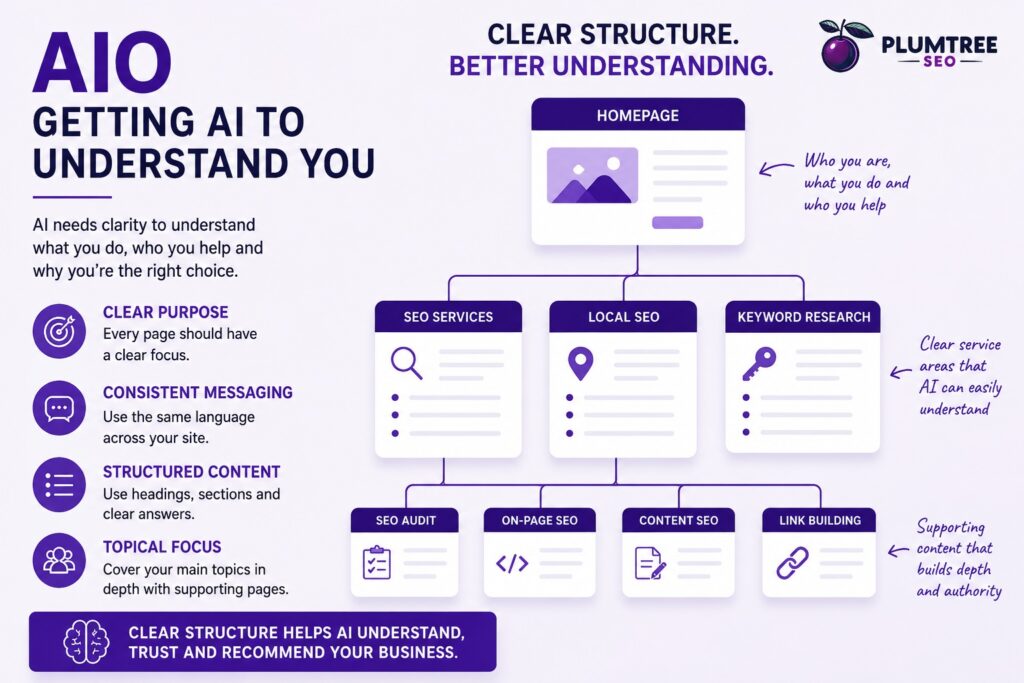
Before AI can recommend your business, it needs to understand it.
That sounds obvious, but this is where most websites fall short.
They try to rank for everything.
They cover too many topics.
Their messaging changes from page to page.
From a human perspective, it might still make sense.
From an AI perspective, it creates confusion.
AIO is about removing that confusion.
It’s making your website and content easy to interpret, so AI can clearly answer:
- What does this business do?
- Who is it for?
- Where does it operate?
- Can it be trusted?
If those answers aren’t obvious, you’re unlikely to be included in AI-driven results.
What this looks like in practice
You don’t need to overcomplicate it.
Strong AIO usually comes down to a few fundamentals.
Clear positioning
Each page should have a clear purpose.
Avoid trying to rank one page for multiple unrelated topics.
Consistent messaging
Use the same language across your site.
If you’re an SEO agency, say that clearly and consistently.
Structured content
Use headings properly.
Break content into sections.
Answer questions directly.
This helps both users and AI tools understand your content quickly.
Topical focus
Cover your main topics in depth.
Not just one page, but multiple supporting pages.
This is where your keyword research still plays a role.
It helps you understand what people are asking, so you can build content around real intent.
Why this matters more now
In traditional SEO, you could sometimes rank with a well-optimised page, even if your overall site wasn’t perfectly structured.
AI doesn’t work like that.
It builds an overall understanding of your brand.
If your content is clear, consistent, and focused, that understanding becomes stronger.
If it’s scattered, your visibility drops.
Quick takeaway
If AI can’t clearly explain what you do…
it won’t recommend you.
GEO – Getting Recommended by AI
Understanding your business is one thing.
Recommending it is another.
This is where GEO comes in.
GEO (Generative Engine Optimisation) is about increasing the chances of your business being mentioned, cited, or suggested when AI tools generate answers.
Not just listed. Not just linked.
Recommended.
That’s a different level of visibility.
How AI decides what to include
AI doesn’t just look at one page and make a decision.
It looks for patterns across multiple sources.
It asks:
- Does this brand show up consistently?
- Is it mentioned in different places?
- Do other sources refer to it?
- Does it appear in real conversations?
If the answer is yes, your chances of being included increase.
If not, you’re far less likely to be selected.
This is why some businesses appear in AI answers… even if they’re not ranking number one in Google.
Why being “everywhere” matters
One of the biggest shifts in SEO is this:
Your website is no longer your only signal.
AI tools learn from a much wider set of data.
That includes:
- blog content
- LinkedIn posts
- forums like Reddit or Quora
- industry websites
- reviews and mentions
If your business only exists on your website, your visibility is limited.
But if your brand appears across multiple platforms, something interesting happens.
You start to look established.
Recognised.
Trusted.
And that’s exactly what AI is trying to identify.
What this looks like in practice
You don’t need to be everywhere overnight.
But you do need to show up in more than one place.
For example:
- sharing insights on LinkedIn
- contributing to discussions in your industry
- getting mentioned in blogs or articles
- building a presence beyond your own site
Over time, these signals build.
And AI starts to recognise your brand as part of the conversation.
Why this matters more than rankings
Ranking is still important.
But ranking alone doesn’t guarantee inclusion in AI answers.
You could rank well for a keyword…
…and still not be mentioned when someone asks a broader question.
Because AI isn’t just looking for the “best page”.
It’s looking for the most trusted and relevant sources.
Quick takeaway
If your business only lives on your website, you’re limiting your visibility.
If your business shows up across the web, your chances of being recommended increase.
Brand Mentions vs Backlinks (What’s Changed)
Backlinks have always been a core part of SEO.
And they still matter.
They help search engines understand authority, relevance, and trust.
But in an AI-driven landscape, they’re no longer the only signal.
The shift you need to understand
Traditional SEO relies heavily on links.
A website links to you, and that passes authority.
Simple.
AI looks at things differently.
It doesn’t just track links.
It looks for mentions, references, and patterns across the web.
That includes:
- your brand being discussed
- your business being named in articles
- people recommending you in forums
- your content being referenced, even without a link
In other words:
You don’t always need a link to be seen.
But you do need to be talked about.
Why mentions matter
AI is trying to figure out what’s credible.
One strong signal is consistency.
If your brand keeps appearing in relevant places, it builds a picture:
“This business is active in this space.”
“This business is recognised.”
“This business is trusted.”
That’s exactly the type of signal AI tools use when deciding what to include.
This doesn’t replace backlinks
It’s important to be clear.
Backlinks are still valuable.
They still help with:
- rankings
- authority
- trust signals
But they now sit alongside a wider set of signals.
Mentions, presence, and consistency all play a role.
If you want a deeper understanding of how backlinks still fit into SEO, you can read our beginner’s guide to backlinks.
What to focus on
Instead of thinking only about links, think about visibility.
Ask:
- Is my brand being mentioned anywhere outside my site?
- Am I part of conversations in my industry?
- Do people refer to my business when discussing this topic?
That’s the shift.
Quick takeaway
Backlinks help you rank.
Mentions help you get recognised.
You now need both.
Keyword Research Has Changed
Keyword research is still important.
But the way people search has changed.
And that changes how you approach it.
How it used to work
Traditional keyword research focused on:
- exact phrases
- search volume
- competition
You’d find a keyword like:
“seo agency leeds”
Then build a page around it.
That still works.
But it only covers part of the picture now.
How people search today
People don’t just type keywords anymore.
They ask questions.
They describe problems.
They use natural language.
For example:
Instead of:
“seo agency leeds”
You’ll see:
“who is a good seo agency for a small business in leeds?”
“how do I find an seo company I can trust?”
This is exactly how people interact with AI tools.
Why this matters
AI tools are built to understand intent.
They’re not matching exact phrases.
They’re interpreting meaning.
So instead of asking:
“What keyword should I rank for?”
You should be asking:
“What questions is my audience asking?”
“What problems are they trying to solve?”
What to focus on now
Strong keyword research now includes:
Questions and intent
Look at how people actually phrase queries.
Topic coverage
Instead of one keyword, cover the full topic.
Clear answers
Make it easy for both users and AI to extract answers.
Where your existing strategy still fits
Your keyword research isn’t wasted.
It’s still the foundation.
It helps you:
- understand demand
- prioritise topics
- structure your content
If you want to go deeper into this, our beginner’s guide to keyword research breaks it down step by step.
The shift in one line
Old SEO was about targeting keywords.
Modern SEO is about answering questions.
Quick takeaway
If your content only targets keywords, you’ll miss a large part of how people search today.
If your content answers real questions, you increase your chances of being included in AI responses.
How to Show Up in AI Search
By now, the shift should be clear.
It’s not just about rankings anymore.
It’s about being understood, recognised, and selected.
So what do you actually need to do?
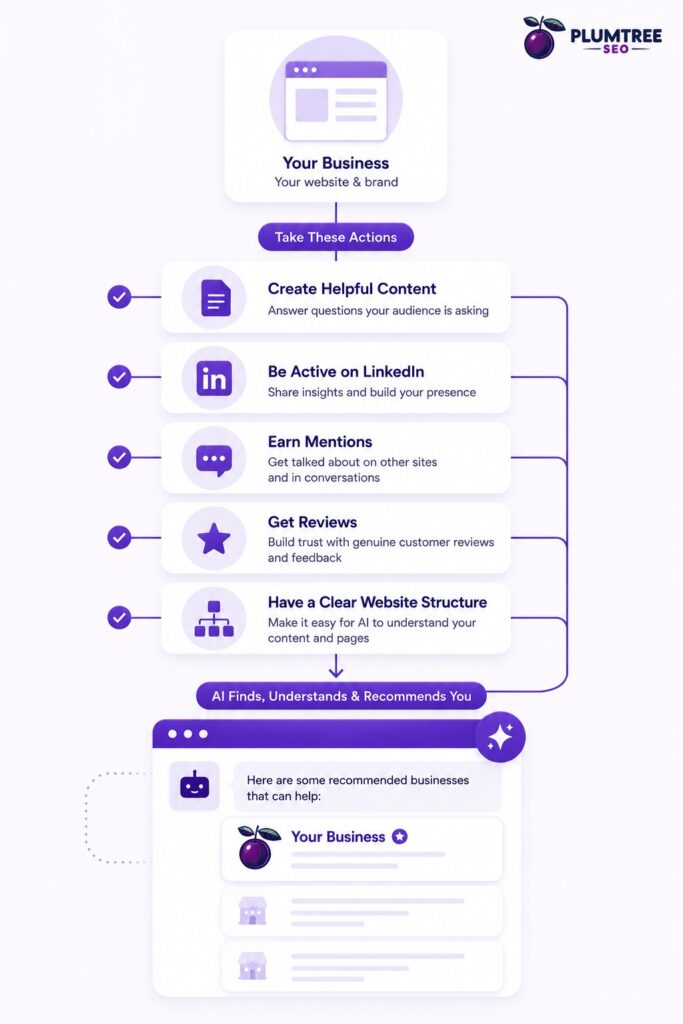
1. Answer real questions clearly
Start with the basics.
Your content should make it easy for someone (and AI) to find answers quickly.
That means:
- clear headings
- short paragraphs
- direct answers to common questions
Avoid overcomplicating things.
If your content is easy to read, it’s easier to extract.
2. Build presence beyond your website
Your website is no longer enough on its own.
AI tools look at a wider set of signals.
So you need to show up in more places.
This could include:
- sharing insights on LinkedIn
- contributing to discussions
- appearing in industry content
- being part of conversations
You don’t need to be everywhere at once.
But you do need to exist beyond your own site.
3. Be consistent with your messaging
AI builds an understanding over time.
If your messaging changes constantly, that understanding weakens.
Keep things consistent:
- what you do
- who you help
- how you describe your services
The clearer you are, the easier you are to recognise.
4. Earn mentions, not just links
Links still matter.
But as we covered earlier, mentions are just as important.
Focus on:
- getting your brand talked about
- contributing useful insights
- being referenced in relevant places
Over time, this builds authority beyond your own website.
5. Create content AI can use
Think about how your content is structured.
Make it easy to extract:
- use clear sections
- answer questions directly
- avoid long, unfocused paragraphs
You’re not just writing for users anymore.
You’re writing for systems that summarise your content.
6. Focus on specific, real-world topics
Broad, generic content is harder to trust.
Specific content is easier to recognise.
For example:
- “SEO tips” is broad
- “SEO for small businesses in Leeds” is specific
Specific content helps AI understand exactly where you fit.
At this point, you’ve probably realised something.
This isn’t just about tweaking a page or adding a keyword.
It’s about building a consistent presence across your website and beyond.
Struggling to show up in AI search results?
SEO today isn’t just about rankings. It’s about visibility across search engines, AI platforms, and the wider web.
If you want help building a strategy that actually works, explore our
managed SEO services.
Quick takeaway
There isn’t one single tactic that makes you appear in AI search.
It’s the combination of:
- clear content
- consistent messaging
- wider presence
- and authority signals
That’s what increases your chances of being selected.
Where This Is Heading
AI search is still evolving.
But the direction is clear.
People are getting answers faster.
They’re clicking less.
And they’re relying more on summaries and recommendations.
We’re already seeing this shift in how users interact with search, with AI-driven results reducing clicks and changing behaviour. If you want to explore this in more detail, read our guide on how AI search is changing SEO.
That doesn’t mean websites disappear.
It means visibility changes.
Instead of competing for a position on a page, you’re competing to be part of the answer.
And that raises the bar.
Because being included isn’t just about optimisation.
It’s about trust.
What to expect moving forward
You’ll likely see:
- more AI-generated responses in search
- fewer clicks for basic queries
- more importance placed on authority and consistency
Businesses that adapt early will have an advantage.
Not because they’re doing something completely new.
But because they’re applying the fundamentals more consistently.
Quick takeaway
The goal is no longer just traffic.
It’s visibility in the places people are actually getting answers.
SEO Isn’t Dead (It’s the Foundation)
There’s a lot of noise around AI replacing SEO.
That’s not what’s happening.
SEO isn’t disappearing.
It’s evolving.
What hasn’t changed
The fundamentals still matter:
understanding your audience
creating useful content
building authority
structuring your site properly
These are the same principles that have always worked.
What has changed
Those fundamentals now feed into something bigger.
They help:
AI understand your business
AI trust your content
AI decide whether to include you
So instead of thinking “SEO vs AI”…
It’s better to think:
SEO supports AIO and GEO.
It’s the foundation that everything else builds on.
Quick takeaway
If your SEO is weak, your AI visibility will be weak.
If your SEO is strong, you give yourself the best chance of being included.
Want to show up in Google, ChatGPT, and beyond?
At this point, the opportunity should be clear.
Search is changing.
Visibility is shifting.
And the businesses that adapt will benefit.
Modern SEO is about more than rankings. It’s about building visibility, authority, and trust across multiple platforms.
If you’re ready to improve your search presence and start appearing in AI-driven results, our team can help.
Explore our
managed SEO services to see how we approach modern SEO.
FAQs:
AIO (AI Optimisation) is the process of making sure AI tools like ChatGPT, Google AI Overviews, and Perplexity can understand your content and your business clearly.
It focuses on structure, consistency, and building trust so your business is recognised as a reliable source.
GEO is about increasing the chances of your business being mentioned or recommended in AI-generated answers.
Instead of just ranking in search results, the goal is to be included directly in responses when users ask questions.
Traditional SEO focuses on rankings.
AI SEO focuses on being selected.
That means:
- answering real questions
- building authority
- appearing across multiple platforms
To improve your visibility, focus on:
- creating clear, structured content
- answering real customer questions
- building authority through links and mentions
- showing up beyond your website
Consistency across all of these areas is key.
Most businesses struggle with this because it requires a mix of:
- content strategy
- technical SEO
- brand positioning
- ongoing consistency
If you want to build a strategy that covers all of these areas, working with an experienced SEO team can help.
👉 You can explore our managed SEO services here.
Yes.
Modern SEO is about more than rankings.
We help businesses build visibility across search engines and AI platforms by focusing on:
- structured content
- authority signals
- brand mentions
- multi-platform presence
👉 Learn more about our SEO services.